
When Tradition Becomes the Enemy
The Admiral Who Broke the Navy in Order to Fix it

Greetings my friend!
I hope you had a good week and are excited for the weekend. I’ve had lots of writing time over the past month. If you’re in my inner, INNER circle you know why. It’s the one and only positive benefit. I’ve just updated my book on performance management. I’m no longer in the industry, but hopefully my words are timeless. Just adding to my legacy I guess and trying to scrape together some bourbon money from book sales. I’ll do the audio for this in a few months so you can read and listen for free, but you can get it now in paperback from Amazon. Just click the graphic below.

Speaking of legacy, that’s the subject of this story. Even if you’re not fully versed in Navy things, you’ll appreciate this one.
Let me tell you a little story…
It’s a Saturday morning in 1976, and I’m riding in the car with my mom, heading to the grocery store. As we come up to a traffic light, I look over at the red, beat-up car on our right. In it are two sailors, wearing white “crackerjack” uniforms, looking somewhat disheveled. Hanging from their rearview mirror is a photo of a topless woman. Funny what you remember when you’re 12. A year later, all I would have remembered would be that topless woman. Either way, the entire scene strikes me as really off, unclassy, filthy. The uniforms were a real turnoff. I’d never want to wear one.
Fast forward seven years. I’m visiting a Navy recruiter. Since I’m having trouble finding a job in my field of dental laboratory technology, my instructors from trade school encourage me to look into the Navy. It’s a way for me to get the experience I lack in the field.
One reason I’m even considering the Navy is that I’ve seen pictures of sailors in uniform, and they’re no longer wearing those dreadful crackerjacks. They look professional. No Dixie cup cover that resembles an upside down dog dish. No horrible bell bottoms. Instead, the men wear a jacket and tie. A crisp combination cap tops off the ensemble. Now THIS is a uniform I’d be proud to wear. Plus, a lot of the men had beards. No other branch of the military allowed this.
But the Navy recruiting station has brochures showing sailors being outfitted in crackerjacks in the pamphlet about boot camp. Surely this must be an outdated piece of marketing material. I wouldn’t be caught dead in crackerjacks.
Imagine my surprise during R&O (receiving and outfitting) in boot camp when I’m measured for blue and white crackerjacks. These are the current service dress blue and white uniforms, complete with “Disco Danny” bell bottoms and a dog bowl cover. The summer whites look like something Elvis wore during his Las Vegas residencies.
I’m forever embarrassed by that uniform. Some of the old salts refer to the dress blues as “panty droppers.” I find that laughable. I can tell you unequivocally that my dress blues never caused that reaction.
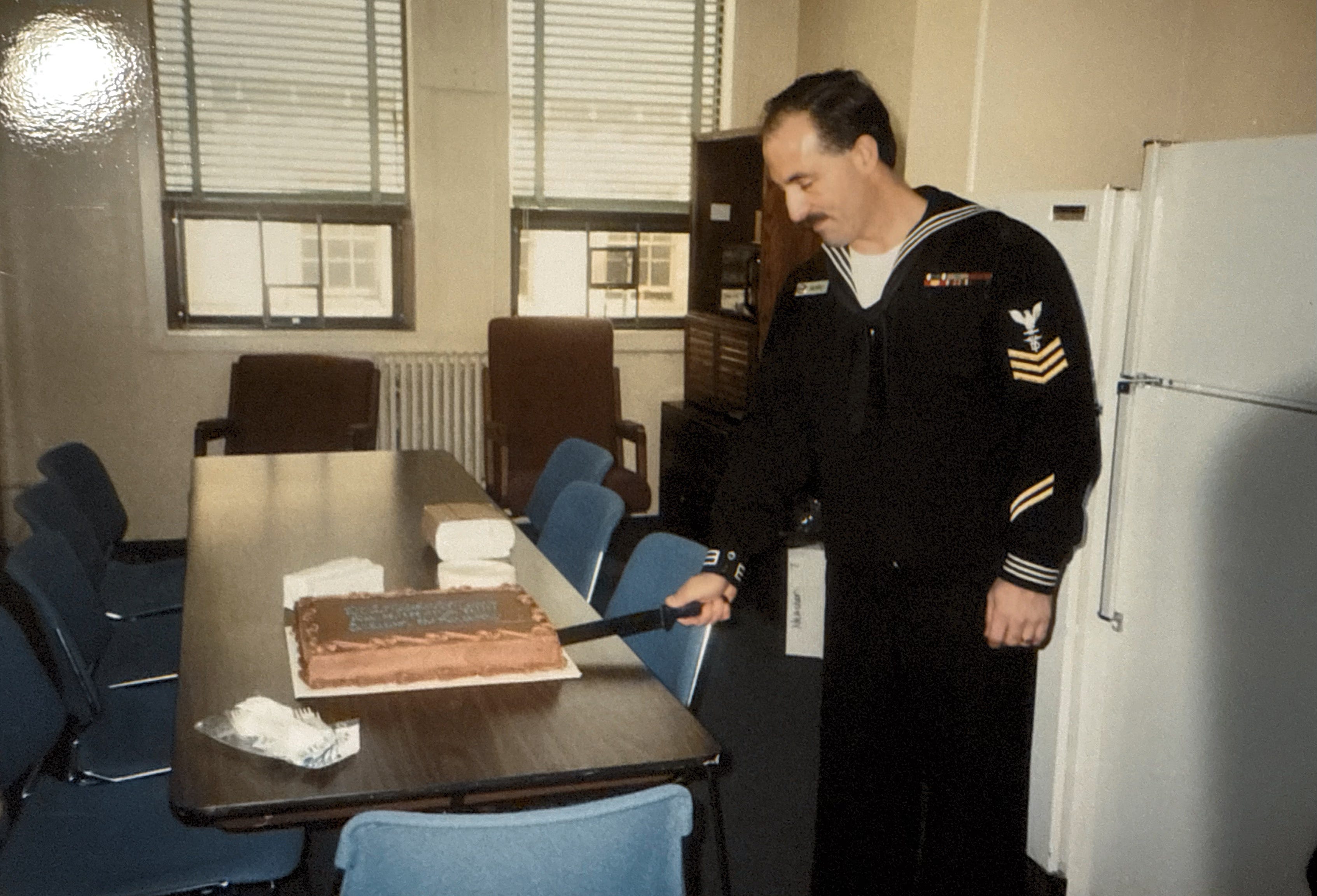
Me wearing my “panty droppers” for the last time at my retirement ceremony in 1999.
When I ask my first supervisor about the old uniforms, he tells me they were phased out just a couple of years earlier—one of the last vestiges of the “Zumwalt era,” which began in 1970. Then, just before I made paygrade E-4, which would have enabled me to grow a beard, the Navy phased that out too.
I hear rumors about Admiral Zumwalt, who served as Chief of Naval Operations (CNO) from 1970-1974. Most of the sailors I worked with early in my career were from the Vietnam era, and they remembered Zumwalt. Not fondly, it seemed. They said he championed the junior enlisted. He worked hard to lessen the hierarchy. He believed that if the Navy treated the junior enlisted well, morale would trickle up. As you might imagine, that didn’t sit well with the senior folks. They missed the opportunity and experience of RHIP (rank has its privilege), which basically gave them license to treat people like shit and get away with it. And I speak from experience here, as a former junior enlisted sailor.
I wondered about him. What motivated him to completely change the uniforms as well as so many other Navy traditions? Why did so many of the old salts view him with disdain? So, I decided to do a little research. Turns out Admiral Zumwalt would have been my soulmate—in the platonic kind of way. Let me tell you some stories about him.
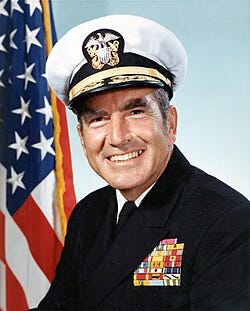
Admiral Elmo R. (”Bud”) Zumwalt, Jr.
When he became Chief of Naval Operations in 1970, the Navy was in a dark place. On one hand, it could launch jets off carriers at night like it was no big deal. On the other, it was still running on rules that felt like they were written for the era of wooden ships. Haircuts mattered more than morale. Tradition beat common sense every single time. And underneath it all, things were starting to fall apart—rampant drug use, Vietnam fatigue, racial tension, and a growing gap between leadership and the people actually doing the work.
Zumwalt saw it because he’d been in it, running what became known as the brown-water Navy in Vietnam. This was real. Theory and plans often failed. You either got it right, or people paid the price. What he learned in Vietnam was simple: systems don’t break when you war-game them in a conference room, they break in the middle of a shitstorm, costing lives. Theory doesn’t translate to the dangerous Mekong Delta.
So, when he took over at 49, he didn’t ease into the job. He came in with an agenda, and he meant to keep it.
He didn’t write politically correct, formal memos that trickled down the chain of command. He dropped Z-Grams—directives that didn’t just tweak policy; they went straight at the culture. He relaxed grooming standards, improved living conditions, opened doors for women and minorities, and fixed a whole bunch of day-to-day bullshit that had been dismissed for years as “just the way it is.”
Every Navy leader wants to make a mark, leave a legacy. Not all are positive. Here’s what made his different.
It wasn’t just that he changed things. Every Navy leader implements changes.
He used his authority like a bulldozer. Opposition to his policies never had a chance. He didn’t wait around for consensus because he understood that the people who benefit from a broken system won’t line up to fix it. So, he moved before they could organize against him.
That pissed off a lot of senior leaders. RHIP was being stolen from them.
But at the exact same time he was pushing change from the top, he was pulling people in from the bottom. His Z-Grams didn’t read like orders from some distant, fat-ass admiral chugging down coffee in the Pentagon. They read like someone talking to sailors like regular human beings. He explained what was changing and why, treating them like the adults they were instead of interchangeable parts of a flawed machine.
And the sailors responded. I sure as hell would have.
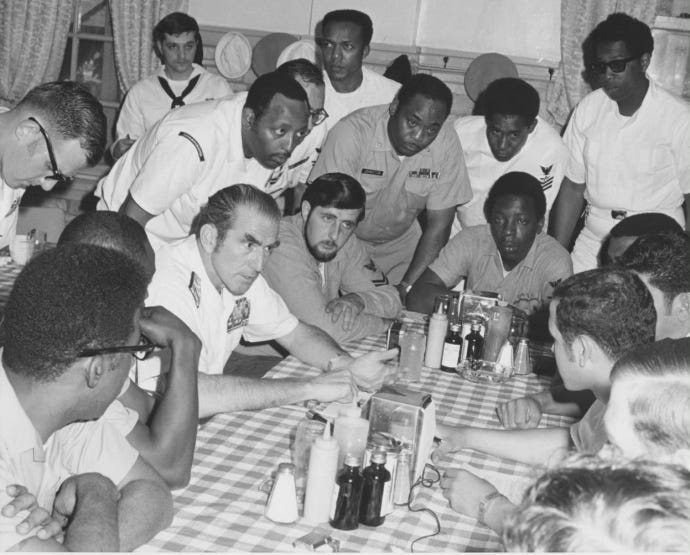
Admiral Zumwalt up close and personal with his sailors. Note the bearded guy with long hair sitting next to him. The sailor in the very back is wearing the dress white “Elvis” uniform probably for the last time before switching to the newly-prescribed uniforms.
For a lot of enlisted folks, Zumwalt wasn’t just another name in the chain of command. He was the first one who seemed to see them. That was important. It gave him something most leaders never build—a real base of trust with the people doing the work.
This divides the Navy. Of course, it always was, but now it was palpable.
The old timers were saying, “This guy’s tearing the place apart. He’s destroyed all our customs and traditions.”
Down below, you’ve got junior sailors thinking, “About fucking time!”
Change is never easy. I remember the phrase “change comes one retirement at a time.” Zumwalt’s response would have been, “Bullshit. I have the power, and I’m making the change right now.”
But there is one more part of his story that solidifies his character.
In Vietnam, Zumwalt supported the use of Agent Orange to clear vegetation along the rivers. It made sense tactically—less cover for the enemy and better visibility for patrols. War decisions are like that. Easy for the slicked-back-hair, ultra-tailored-suit politicians. Devastating for those tasked to carry them out.
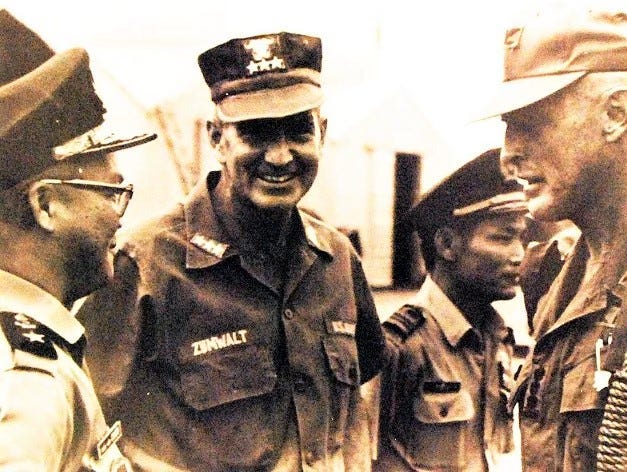
Admiral Zumwalt in the “brown-water” Navy days.
Years later, his son, Lt. Elmo Zumwalt III, who served in those same areas as a Marine Corps officer, got cancer linked to that exposure and eventually died from it.
That put Zumwalt in a difficult position. He ordered the very thing that killed thousands, including his son.
A politician would have waffled, called it a hoax, or claimed “fog of war.”
Zumwalt didn’t. He acknowledged it publicly. He didn’t dodge it or spin it. He leaned into it and became an advocate for veterans exposed to Agent Orange, pushing for recognition, compensation, and accountability.
That tells you everything you need to know about the man.
By the time he stepped down in 1974, the Navy wasn’t perfect. Not even close. But it was different. It looked more like the country it served. It thought a little harder about its people. And it had been forced—whether it liked it or not—to take a long, honest look at itself.
And when Zumwalt was gone, the tide reversed. Which explains why I saw those two sailors in white crackerjacks in 1976. The modern uniforms were already history.
The Navy I thought I was joining in 1983 was long gone. I was sorely disappointed.
When I came in, Zumwalt was a caricature. His Z-Grams were a laughable part of his legacy. I didn’t know why back then, but I do now. And I wish I had the opportunity to serve under him.
Maybe it’s because he didn’t leave behind a quiet legacy. His is one of arguments, debate, progress, and the disruption of tradition.
Zumwalt walked in, saw a machine that still worked but didn’t fit the world anymore, and decided it was better to deal with the pain of change than sit back and watch it slowly rot.
I only wish the changes had stuck. I might have done 20 years instead of 15.
Regardless, I hope I gave Zumwalt his due.
How will people look at your legacy? Who will have the kindest words for you?
Why?
Have an AWEsome day!