

Empathy Part II
The Shoe is on the Other Foot

It’s January 1994, and Barb and I are landing in Agana, Guam after a 15-hour flight. The sun has been up the entire time as we chase daylight across the Pacific and cross the International Date Line.
It’s okay. The farther, the better.
We’ve been married about eight months. It’s been pure hell. My ex created so many problems for us that we long to be at the furthest place from California on the planet. Guam is perfect. We are anxious to have our own place, since we’ve lived with my parents the entire time.
It’s Barb’s first time overseas. I’d been stationed in Australia in the mid-1980s, so this was old hat to me. But something awaited me in Guam that I’d never experienced before. And it would profoundly change my life.
I’m not stupid or arrogant enough to think life isn’t a hell of a lot easier for me simply because I’m a straight, white male. It is. Although back then, if you’d told me that, I’d have laughed at you. I didn’t see any difference between how I was treated and how anyone else was treated. How could I? I lived in the USA. In Southern California. And my overseas experience in Australia meant I was, once again, in a place of comfort and privilege, which of course I didn’t recognize. Australia, after all, is a very white country.
From the moment we land, I sense something very different. Barb and I stand out. A white couple in a sea of dark-skinned Pacific Islanders.
Our sponsors meet us at the airport and drive us to the Inn on the Bay, where we’ll live for nearly two months while awaiting housing. We don’t mind. After living with my parents for eight months, a hotel room is just fine. Before leaving us to sleep off our jet lag, my sponsor, Alan Casusi, gives me a warning.
“Guam is a different place. You’ll have to adjust your expectations.”
I blow it off.
The next day, I find out what he means.
Alan picks me up the next morning. Barb goes with her sponsor, Nanette Davis, since she’s at a different command. We check in and begin the long process of getting everything arranged. The first order of business is getting my truck.
Barb and I could both ship cars to Guam since we’re both on active duty. I shipped my Mazda pickup two months earlier so it would be waiting for us. We shipped Barb’s car just before we left.
Alan and I arrive at the shipping office. It’s packed. A Chamorro man works the desk. Chamorros are the native Guamanians. In some ways, they’re similar to Hawaiians and Samoans, both in appearance and culture.
The guy at the desk is a complete ass. He’s rude, slow, and apparently highly unmotivated. For newbies like me, this is unacceptable. One of the people waiting gets impatient and walks up to the window to go off on him. The clerk stands up, slams the window shut, and announces he’s going to lunch. No time frame. No explanation. And it’s only 10:30.
“What the fuck?” I say to Alan.
And then he tells me a phrase that’s still embedded in my brain today.
“This is Guam.”
My initial response is, “No, this is bullshit!”
I learn quickly that the phrase is both a statement of fact and a coping mechanism. A way to stay calm when you want to rip someone a new one. It was bullshit. Still is. But I believe it was exactly what I needed to experience.
My next stop is the Guam version of the DMV to get a driver’s license. DMVs are dysfunctional everywhere I’ve ever lived. I suppose if we ever find a planet with intelligent life, there will be a dysfunctional DMV there too.
I’m waiting in a long line, standing out like a white sore thumb. I’m next to be served. Then the clerk motions to the people behind me to come to the window. They’re Chamorro. They cut the line ahead of the white guy.
I’m pissed.
Then I hear Alan’s voice again.
“This is Guam.”
That weekend, Barb and I go for a drive. We pass the gate to the Naval Communications base. And that’s when we see it. Protests. Right outside the gate. A group of Chamorros holding signs, chanting and dancing around an American flag hanging upside down.
After a week of “this is Guam,” I’m livid. I pull the car over, ready to run out and rescue the flag. Barb wisely holds me back. When I ask Alan about it later, he fills me in.
Guam was a remote outpost with a small contingent of U.S. Marines. When the Japanese invaded in December 1941, the Marines fought bravely before being captured. The Japanese then had the island to themselves. They brutalized the native Chamorros. One of their favorite atrocities was taking an infant from a mother’s arms, tossing it in the air, and catching it on their bayonets.
It was hell.
When the 3rd Marine Division retook the island in 1944, landing on Tumon Bay, they destroyed the remaining Japanese forces and restored the airstrip. Guam would play a pivotal role in the final months of the war in the Pacific.
And the people were grateful. So grateful that landowners gave their fields to the Americans.
“Build your bases here so this never happens to us again.”
We paid them and built Andersen Air Force Base, a naval hospital, shipyards, magazines, communications stations, and other support facilities. The bases provided jobs and security. Everyone was happy.
Until the children of those landowners wanted to be paid again. So the government paid them.
Then the grandchildren came along and wanted to be paid again and get the land back.
There was a new cash cow in town: Asian tourists from Japan and Korea. Hotels and resorts ringed Tumon Bay, the very place Marines landed 50 years earlier. The U.S. military sat on some of the best land on the island. They wanted hotels and resorts. We refused.
That’s when the protests escalated.
Activist Angel Santos led the charge, at one point headbutting a Marine sentry who couldn’t fight back. It was getting ugly.
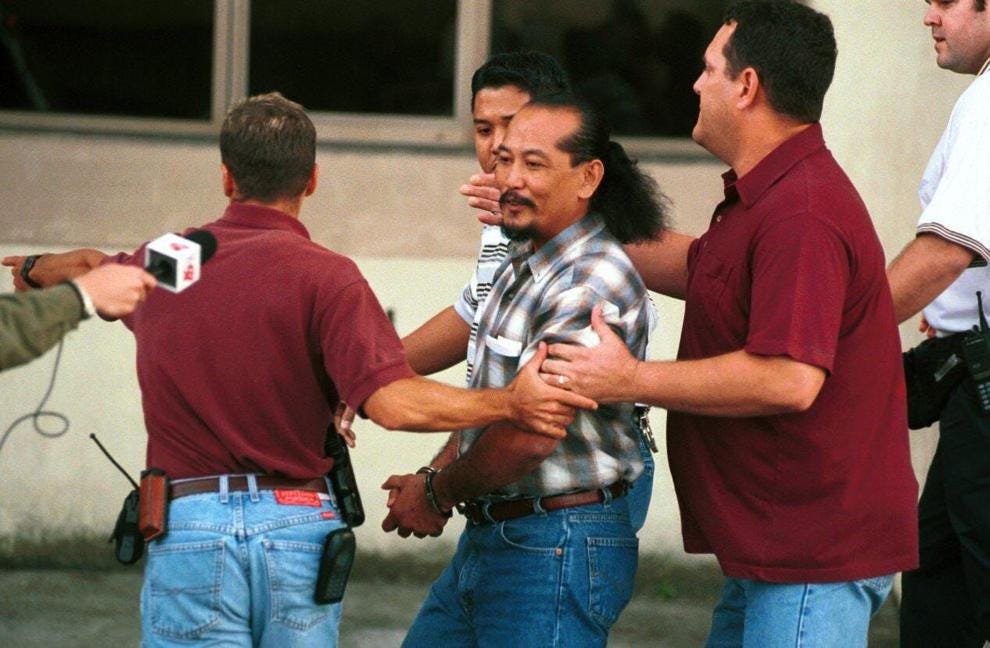
Angel Santos under arrest.
Now, not only did I stand out, I realized something worse: most of the people around me hated me.
Barb and I moved to the village of Tamuning and bonded with fellow shipmates and a small expat community from New Zealand. Over the two years we lived there, I felt conspicuous every time we were in town. In grocery stores. On public beaches. One day, sitting at a red light in downtown Agana, I felt someone staring at me. I looked left. A Chamorro man sat in the car next to me, calmly giving me the finger.
We were haoles. The white people.
For the first time in our lives, we felt unwelcome.
It’s not a good feeling.
After two years, we returned to the States. Back to normal. But I came back changed. I’d spent two years in an alternate universe, and my eyes were open. When you don’t fit in physically, it hurts twice as much. Being invisible is one thing. Being stereotyped is worse.
At first, I had no animosity toward the people of Guam. But it didn’t take long for it to build.
Jeff Foxworthy had just released his “You might be a redneck” bit. “If you’ve ever mowed your grass and found a car, you might be a redneck.” We improvised our own version.
“If every single person you know all share the last name Cruz, you might be a Chamorro.”
(Cruz is the most common last name on Guam.)
I’m not proud of that joke. Or the many others we made.
But I understand how it happens.
Stereotyping doesn’t start with hate. It starts with friction. With discomfort. With feeling unseen, disrespected, or pushed to the margins. It starts when you’re tired, angry, and looking for a shortcut to make sense of the people around you.
I didn’t arrive in Guam with animosity. I earned it slowly, moment by moment, standing in lines I didn’t get to finish, watching rules bend around me, feeling eyes on my back. That doesn’t excuse what came next, but it explains it.
And explanation matters. Because once you understand how stereotyping forms, you can interrupt it before it hardens into something worse.
Here’s what I learned.
First, sit with the discomfort instead of explaining it away.
My instinct was to label everything I didn’t like as incompetence, laziness, or disrespect. That was easy. What was harder was admitting I was out of my depth. I wasn’t being targeted personally. I was experiencing what it feels like to live outside the default setting.
Discomfort is information. If you rush to explain it away with stereotypes, you miss the lesson it’s trying to teach you.
Second, separate systems from people.
“This is Guam” wasn’t an excuse. It was a reminder. I was angry at individuals when what I was really running into were systems, history, unresolved trauma, and long memories. I blamed the guy at the desk when I didn’t yet understand the centuries of power dynamics that put both of us in that room.
When you confuse systems with people, frustration turns into prejudice. When you separate them, you regain clarity.
Third, catch yourself when humor turns into armor.
That Cruz joke didn’t come from malice. It came from self-defense. Humor became a shield. A way to feel superior when I felt small. That’s a dangerous pivot point. Because once humor starts punching down, it stops being funny and starts being corrosive.
If you feel the need to reduce a whole group of people to a punchline, pause. Ask what you’re protecting and why.
Guam didn’t make me a better person overnight. It did something more important.
It made me aware.
For two years, I lived without the invisible cushion I didn’t even know I had. I learned what it feels like to stand out, to be judged before you speak, to have your presence carry baggage you didn’t pack yourself.
That experience didn’t just change how I see others. It changed how I see myself.
Stereotyping thrives in ignorance and comfort. It withers in awareness and humility. If we’re willing to stay curious when we’re uncomfortable, separate people from systems, and check ourselves before bitterness turns into belief, we can stop it early.
Not perfectly.
But intentionally.
And that’s where real change starts.
Great points to think about!
really interesting, mack